Visualisering för universell utformning i plan- och byggprocesser
Universal-design intentions are stated in early visions and then disappear before the building is finished. Can visualisation tools keep them visible the whole way through?
Visualising Universal Design in Planning and Building Processes
- Funder
- VINNOVA
- Period
- 2021 – 2025
- PI
- Charlotte Magnusson (Lund University, LTH)
- Coordinator
- Lund University (LTH, Department of Design Sciences)
- Funding
- Funded by VINNOVA: 4,990,832 SEK, under Social Sustainability in the Physical Environment. Charlotte Magnusson was PI; I led the iterative concept-development work package.
What this project is asking
This project sat next to The Syntax of Equality, in the same VINNOVA call and the same Lund and Gothenburg milieu, and took on a specific problem. Our earlier research kept finding the same thing: the values and qualities tied to Universal Design are written into the overarching visions of early planning stages, and then cannot be read off the finished building. They fade in the gaps between phases, when one set of actors hands a project to the next.
So the project built a toolbox of visualisation tools, materials and methods, meant to make Universal Design legible at each stage of the plan-and-build process. Tools for insight (how to think about human diversity) and concrete supports for specific stages: consequence analysis with respect to Universal Design, games and short films for empathy, personas and scenarios, checklists that make "this affects that" visible, and lighter AR and VR simulation built on Gothenburg's digital twin, also as support for citizen consultation.
The aim was practical: make potential goal conflicts visible early, when they can still be handled without costly retrofits, so that a city builds right from the start and ends up with an environment that works for a diversity of people. For me, the project is also the direct ancestor of the digital-twin and visualisation work now carried forward in Provtryck Konsekvenserna and Visualisering för Trygghet och Tillgänglighet.
Method
A four-year, exploratory project in five work packages: analysis of the key universal-design qualities at stake in each planning stage. Iterative concept development of candidate tools. Prototype development. Evaluation in real processes in Gothenburg and Lund. And continuous dissemination, including a network for people working in urban planning.
The toolbox took existing tools as a starting point, then tailored new ones to specific stages of the process, developed and evaluated iteratively in workshops and user tests with the City of Gothenburg and Lund Municipality, and released openly at the end so that any municipal plan-and-build process could use it.
Partners
- Lund University (LTH, Department of Design Sciences)
- City of Gothenburg
- Lund Municipality
Co-investigators
- Per-Olof Hedvall (Lund University, led the concept-development work package)
- Lilian Müller (Lund Municipality, accessibility. Industrial PhD student at Certec)
- Andreas Johansen (Lund University)
- Emil Erdtman (Lund University, Certec)
Outputs
- An openly available toolbox of visualisation tools, methods and training material for Universal Design in planning and building
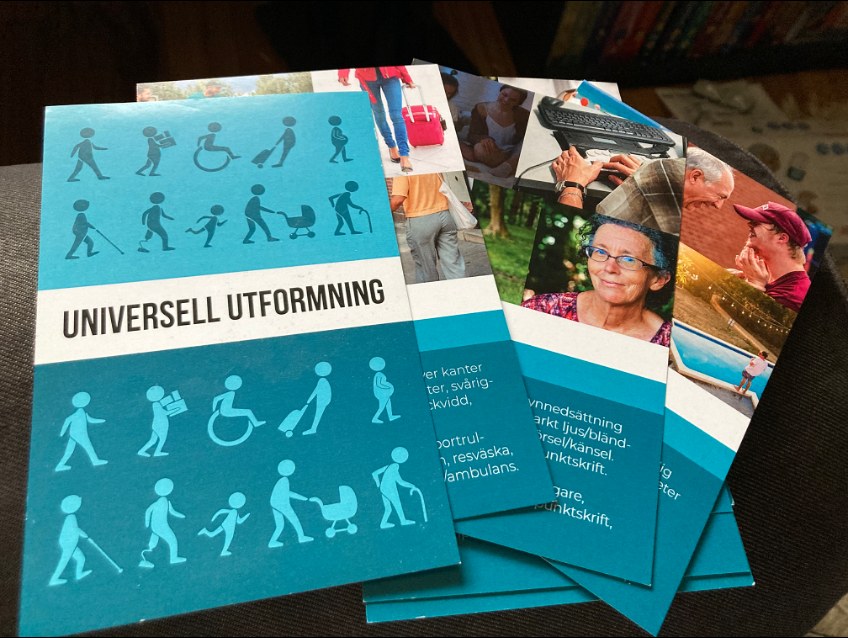
- The design card deck Universell utformning i den byggda miljön (Magnusson, Müller, Sandström, Bernström Printz, Stjernholm, Hedvall & Rassmus-Gröhn, 2025): thinking cards for Universal Design in planning and building processes, open access
- Presented, with the city's wider Universal Design work, on Göteborgs Stad's own Universal Design page
- Emil Erdtman’s doctoral studies of Universal Design in municipal practice ran alongside the project from 2021, with the project’s colleagues among his advisers; see his thesis Universell utformning i praktiken (2024)
- Magnusson, Müller, Sandström & Hedvall (2024), Universal design: Visualising diversity, in the Difference volume (Design for All Institute of India)
- Tools and methods taken up in the planning practice of the City of Gothenburg and Lund Municipality
- The digital-twin and visualisation experience that Provtryck Konsekvenserna and Visualisering för Trygghet och Tillgänglighet now build on
- Part of the ground for Lilian Müller’s doctoral thesis Bridging the Gaps (2023): Müller, Erdtman & Hedvall (2024), Is the City Planned and Built for Me? (JACCES 14:1, open access) drew partly on go-along interviews carried out within this project