Design for situations
Design for what is going on, not for kinds of people. Circumstances, activities, and contexts vary and shift. A design that addresses the situation covers everyone who is in it.
These are places to begin designing from, not standards to audit against. Every example below exists, photographed or quoted as I found it. Each move names a design act or a text act, something you do as you build or write, which then often shows in the result.
Make the question not arise
Design move · also under: Categorise the environment, not the body or the person
Build so that access does not become a topic. What shows it worked is a place with nothing particular to point at.
What it resists: the accessible entrance around the back, and the need for a story at all.
The Marbella street — old town, Marbella
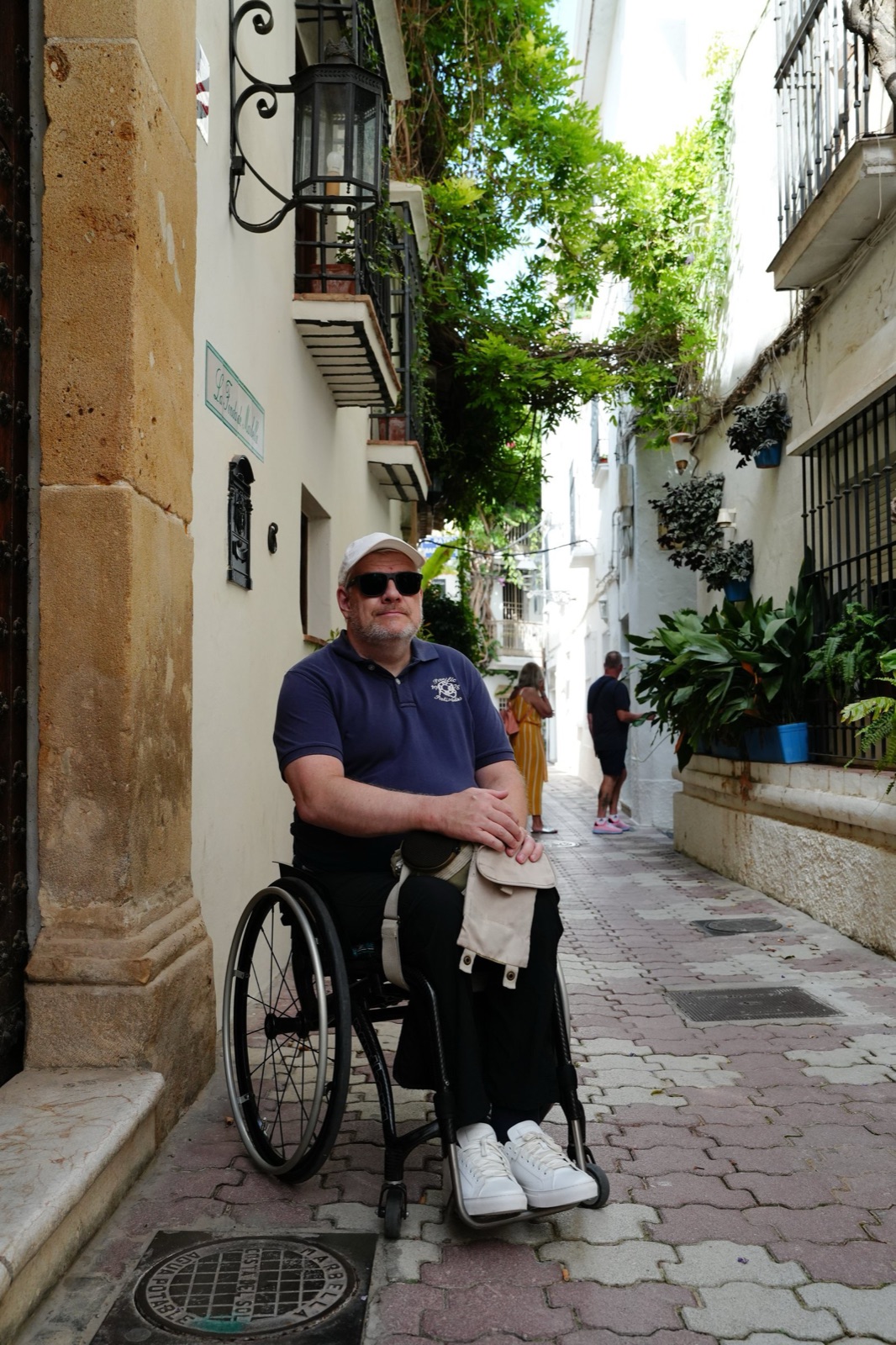
Me, in the middle of the street, unremarkable. Smooth paving joins the whole passage, plants and lanterns stand beside the route rather than in it. I have a series of self-portraits at inaccessible places. This is the opposite photograph: a self-portrait at a place where the question never comes up. The best places in my collection are the ones with the least to point at. That is why they are valuable, even if they are not perfect. They are the evidence that ordinary streets can already do this.
The flagstone strip through the cobbles — Bornholm
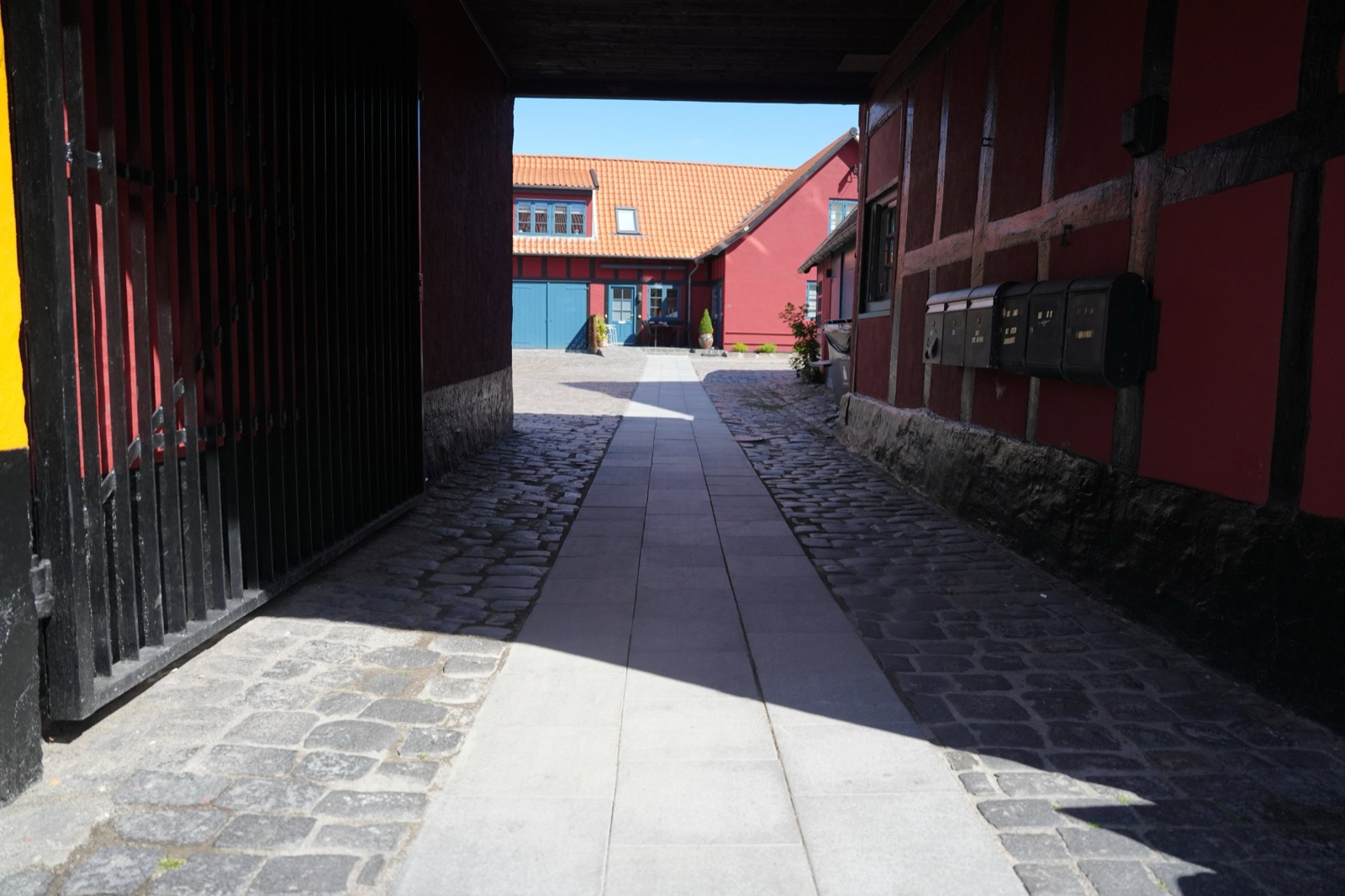
A covered gateway passage between half-timbered houses, floored with rough cobblestone, and straight through the middle runs a smooth flagstone strip. Wheels and feet get a level path, and the cobble texture at its edges lets a white cane sweep and follow along. Three modalities served by one unmarked surface. Nothing announces it, and nobody needs to ask.
The form that never asks — web checkouts
A good checkout asks for what the errand needs: a name, an address, a way to reach you. No title, no gender, no date of birth, because nothing downstream uses them. Every field a form drops is a question that never has to be answered. This is the digital version of the move: delete the field. Nothing to point at, nothing to explain, and the errand just gets done.
Contributes to the shift from explicit to tacit. A street where access is not even a question completes the shift: nothing is left to point at.
Describe the circumstances, not fixed classes
Text move
Describe differences as circumstances in people’s lives, not as fixed classes of people. Then variation becomes the starting point, and no imagined average user stands behind the sentence.
What it resists: the fixed list of classes, age, gender, “girls”, “old people”, and the made-up “average user” that such lists create.
“Every single user” — SS-EN 17161, Swedish edition (a standard in force today)
Every single user has their own profile of needs, properties, abilities, and preferences /…/ The abilities of most people change considerably during their lifetime, from childhood, to adulthood, and old age. Besides, changed circumstances, accidents, diseases, and other life-changing events can lead to considerable change regarding needs, properties, abilities, and preferences.
Sometimes a solution can be to describe a single individual’s circumstances or the situation they find themselves in, as is done here. This is found in EN 17161, a European standard in force today. The same standard elsewhere defines Design for All as reaching “the widest range of users”, a phrasing that still divides people into a majority and the rest. One and the same document can carry both the old habit and this passage. That is why I read one passage at a time, instead of judging a whole document at once.
Contributes to the shift from person to situation. Writing differences as circumstances rather than classes turns the reader from a category member into a person in a situation.
Describe the activity, not the anatomy
Design move · also under: Categorise the environment, not the body or the person
Address what people do, not what bodies they have. Whoever the description fits is who the room is for.
What it resists: the trousers-and-skirt figures on the doors, where body shape decides who may enter.
“For everybody who pees standing up” — venue toilet, France
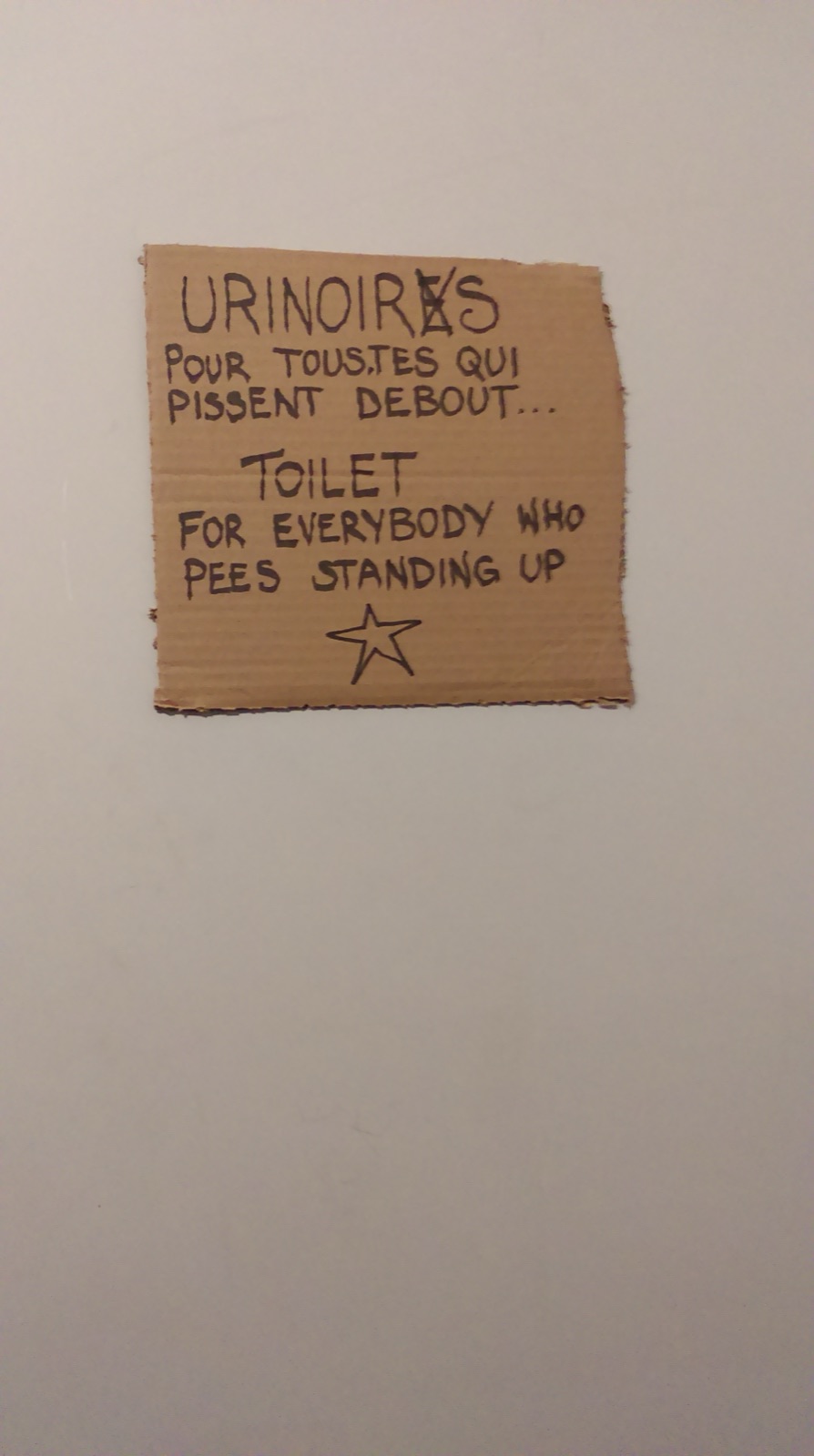
A handwritten sign (sent to us by an anonymous participant) that corrects itself in the middle of a word: the gendered French ending is crossed out and replaced with tous.tes. Then, in English: for everybody who pees standing up. The sign describes an activity, not a gender and not a body type. And the materials show that the move costs nothing. A marker pen, and the decision not to sort people.
Contributes to the shift from person to function. Addressing what people do instead of what bodies they have shifts the door’s question from who you are to what you are here to do.
Locate the problem in the norms, not the people
Text move
Change what the sentence is about: not the group that is harmed, but the norms that cause the harm.
What it resists: texts that describe a group as if the group were the problem.
“Based on norms” — Swedish policy text (rewritten in our Syntax of Equality project, translated from Swedish)
Discrimination, harassment and bullying at work are based on norms regarding gender and sexuality.
Nobody loses their protection. What disappears is the idea that the group is the problem. The original said: “Research shows that LGBTQI people, compared to other employees, are more often subjected to offensive treatment, harassment and bullying at work.”
Contributes to the shift from person to situation. Moving the problem from a group to the structures around it relocates the design task to where design can act.
Solve the level. The ceremony can stay
Design move · also under: Meet variation with variation
Fix the ground first. When the step is gone, a celebration is just a celebration instead of working as a barrier.
What it resists: the carpet rolled over a step: the image that started my whole collection of red-carpeted barrier photos.
“Julen är här” (Christmas is here) — galleria entrance, Sweden
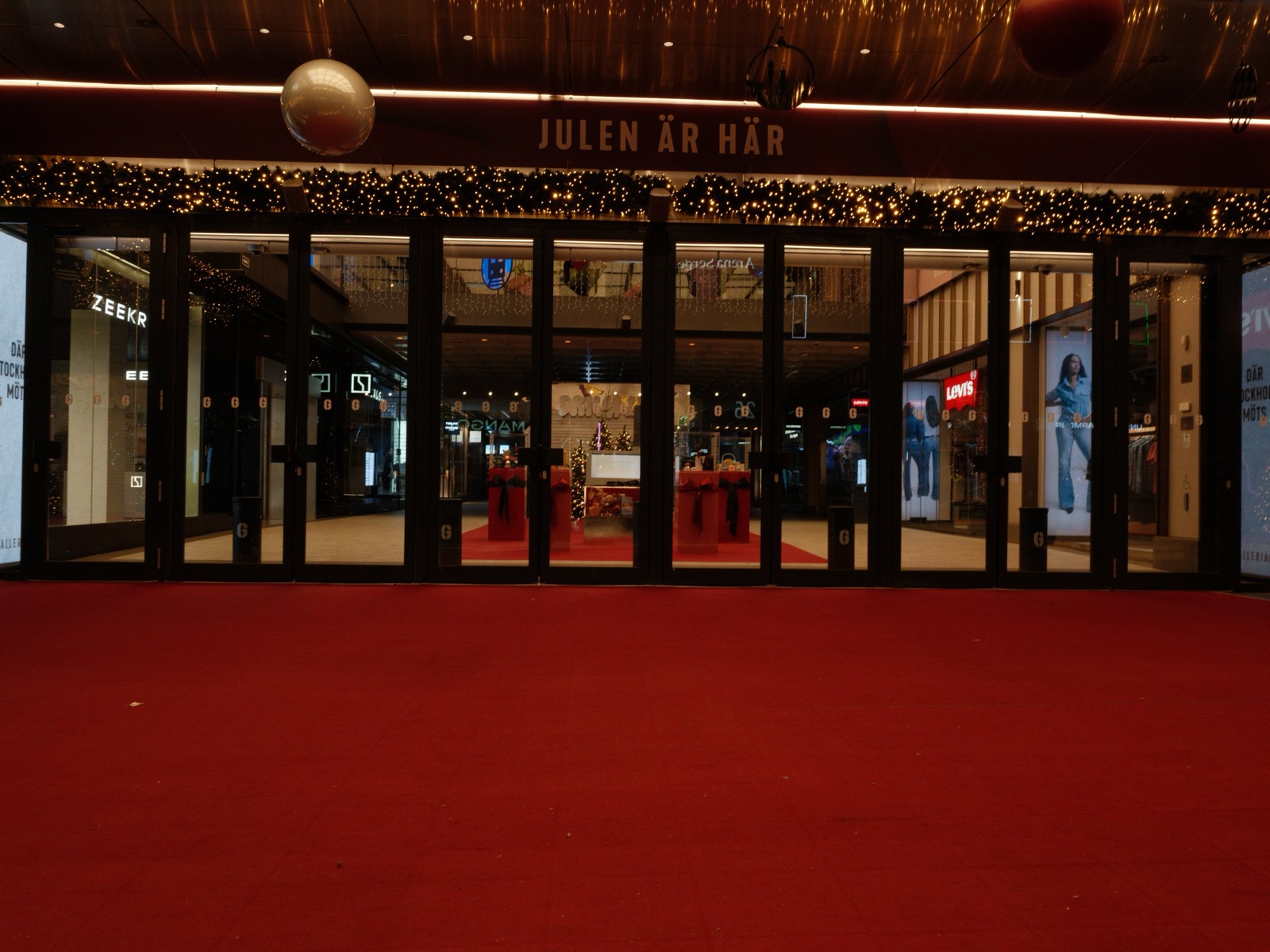
“Julen är här” means “Christmas is here”. This photo is the counter-example in my own red-carpet collection. Twenty photographs show carpets rolled over stairs, where the celebration works as a barrier. Here the ground is level, the doors are wide, and the same red carpet is simply festive. The good example is not the carpet. It is the level ground underneath it.
Contributes to the shift from reactive to proactive. If the ground is solved first, the celebration can take place at any time afterwards.
Where these come from
The moves on this page are grounded in published research and in my own field photography. If you want to dig deeper, here is what each work carries:
-
Hedvall, Price, Keller & Ericsson (2022): Towards 3rd Generation Universal Design – Exploring Nonclusive Design
The paper where nonclusive design is defined: design that resists categorisations of bodies and roles, without predefined limits on whom it is meant for. It asks what categories a design embeds and why, and it lays out the shift this page builds on as a possible third generation of Universal Design.
-
Ericsson & Hedvall (2024): Situation, Non-Categorisation and Variation – Conveying Nonclusion Through Text and Image
The chapter this page is built on. It develops three guiding concepts, Situation, Non-Categorisation and Variation, and shows with concrete text and image examples how focus can be placed on contextual factors rather than on individuals and their properties.
-
Hedvall (2007): Situerad Design för Alla – till improvisationens lov (licentiate thesis, in Swedish)
The thesis where my situation argument began. It turns against dividing people into with and without disabilities, and its method chapter already carries this page’s premise in one sentence: every situation must hold possibilities for everyone.
-
Ericsson, Wojahn, Sandström & Hedvall (2020): Language that Supports Sustainable Development – How to Write about People in Universal Design Policy (open access)
A study of how Universal Design policy writes about people, with seven concrete recommendations for language that supports sustainable development. Useful when the situation you are designing is a text.
-
Who Are All These “Others” In Policy Texts? — Nonclusive by Design #5 (2025)
The newsletter edition that walks through the “others” of policy texts in a ten-minute read. A lighter entry point than the papers, and free to share.
The full publication list is on the CV page. More on the How-to page.