Hi there 👋 I hope you’re having a great summer. For me, the summer has held several visits to new places with my family, and with that, new experiences and new thoughts.
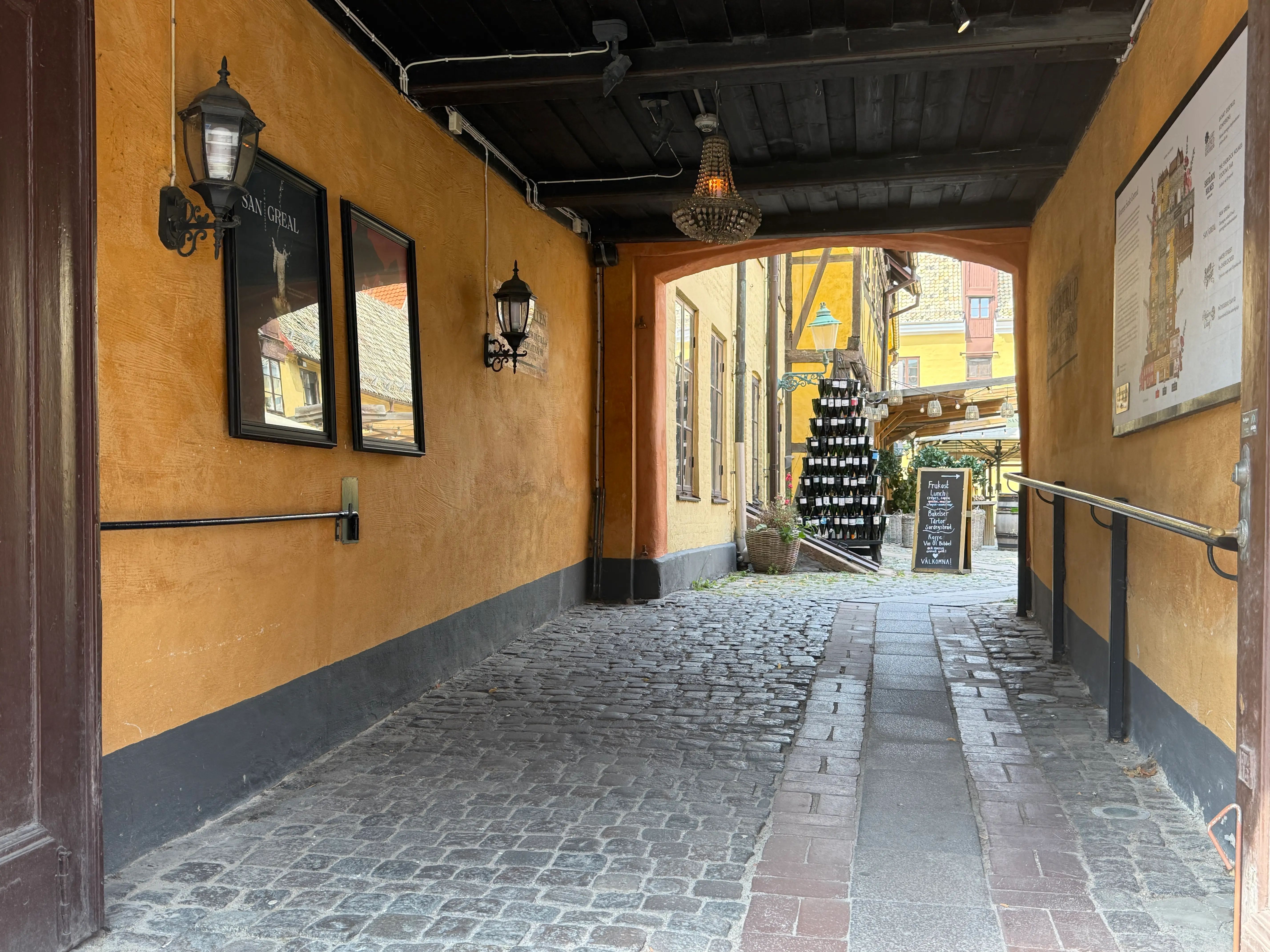
In the photo above (Figure 1), I am entering the passage to an existing, old courtyard that had been retrofitted with a band of smooth stones laid through the cobblestones and a metal handrail along the wall. This is the route everyone walks, not a marked alternative route beside the main one.
It’s when I’m with my family that I notice most if I’m being singled out, led along separate routes, or left outside by poor design. But this is also when I notice design where I can just go with the flow, assumed and unmarked, spending time in togetherness.
Dignity Is Inherent. Design Can Support It.
One of my heroes in Universal Design is Patricia Moore. She is one of its pioneers and has won many prizes for her dedication to dignity by design [1].
Every person has inherent worth and dignity simply by being born. It exists whether or not design acknowledges it. But every design decision can either recognise and support that existing dignity or undermine and violate it. A place is made up of a thousand such decisions.
The foundations for people’s inherent dignity are strong:
- Article 1 in the Universal Declaration of Human Rights says that “All human beings are born free and equal in dignity and rights.” [2]
- Article 1 in the UN Convention on the Rights of Persons with Disabilities (CRPD) says: “…to promote, protect and ensure the full and equal enjoyment of all human rights and fundamental freedoms by all persons with disabilities, and to promote respect for their inherent dignity.” [3]
In both texts, dignity is something to be recognised, never created, granted, or given. The Universal Declaration says people are born equal in dignity. The CRPD adds the verbs respect, promote, protect, and violate. Dignity is always already.
This is similar to saying I already belong. Neither belonging nor dignity is something design creates, and both are there from the get-go. That is what we mean by nonclusive design: it starts from “already” rather than from “not yet” by resisting categorisations of bodies, roles and persons as being outside, in need of being let in.
We are all already part of human variation, and we all have dignity. Every single I. Every single you.
Dignity as a Design Lens
As someone who has been using a wheelchair for more than thirty years, I have firsthand experience of situations where design has made me feel less worthy or undignified.
Design can’t create or give someone dignity, but it can create conditions where their dignity is respected and supported.
Dignity is also a helpful lens when it comes to teaching Universal Design. There are some things I try to keep in mind when working together with our design students. In their crudest, most distilled form, they are:
- Ask questions that don’t position people as problems to solve.
- Focus on what people are trying to accomplish.
- Listen for what supports people’s activities.
- Be sceptical of framings that assume deficits in people.
- Spend more time understanding context and situation.
- Consider the emotional experience and the (often invisible) work people have to put in.
Much of it contributes to a shift in focus from a person “to dignify” or “to include”, towards the environment, system and situation [4, 5]. Compare, for instance, “users don’t understand X” to “our current design doesn’t communicate X clearly”.
For me, this is a matter of attention. People arrive with existing capabilities, values, and agency, not as problems to solve. What matters is what they are trying to accomplish, i.e., their desired outcome and how design can support that [6]. It is useful to ask what an ordinary day looks like when everything goes according to plan, and then listen intently. What supports flow is more tacit than what impedes it, and design that concentrates on “loud” barriers often misses where the potential and the design openings are [7].
I frequently ask students to listen for and consider the emotional experience and the invisible work people have to put in. Who carries the burden [8]? A banking app that assumes you understand financial concepts puts the burden on you rather than explaining things clearly.
By designing with people and with respect for people, design can become more about protecting dignity than about problem-solving.
Your Turn
Dignity is inherent, not a future state to be achieved, and design recognises or denies it.
However, the list above is in no way exhaustive, and I would like to ask you:
What would you like to add to it?
Where can you go with the flow, assumed and unmarked?
Let’s keep this discussion going 😊
Notes and References
Thanks to all of you who share your thoughts and examples!
This piece builds on our work on nonclusive design. Subscribe above to receive future editions and join the conversation.
Do you want to use the photos or illustrations in a publication, presentation, or video? Go ahead, and please tell me what you learn, so I can learn from you 👍
References
- Dowdy, C. (2025, January 6). ‘Dignity by design’ – Dr Patricia Moore on true inclusivity. Design Week. https://www.designweek.co.uk/dignity-by-design-dr-patricia-moore-on-true-inclusivity/
- United Nations. (1948). Universal Declaration of Human Rights. https://www.un.org/en/about-us/universal-declaration-of-human-rights
- United Nations. (2006). Convention on the Rights of Persons with Disabilities. https://social.desa.un.org/issues/disability/crpd/convention-on-the-rights-of-persons-with-disabilities-crpd
- Hedvall, P.-O., Price, M., Keller, J., & Ericsson, S. (2022). Towards 3rd Generation Universal Design: Exploring Nonclusive Design. Transforming Our World through Universal Design for Human Development, 85–92. https://doi.org/10.3233/SHTI220824
- Ericsson, S., & Hedvall, P. O. (2024). Situation, Non-categorisation, and Variation—Conveying Nonclusion Through Text and Image. In Difference – Sketching, Visualising and challenging Universal Design in Sweden (Vol. 19, pp. 31–50). Design for All Institute of India. http://designforall.in/?mdocs-file=2472
- Hedvall, P.-O. (2009). The Activity Diamond – Modeling an Enhanced Accessibility. Doctoral thesis, Certec, LTH, Lund University. https://lup.lub.lu.se/search/publication/3c899bb0-2cb2-40fe-9126-651c06815b01
- Larsen, H. S., & Hedvall, P.-O. (2012). Ideation and ability. Proceedings of the 12th Participatory Design Conference on Exploratory Papers, Workshop Descriptions, Industry Cases - Volume 2 - PDC ’12, 37. http://dl.acm.org/citation.cfm?id=2348144.2348157
- Grue, J. (2023). The CRPD and the economic model of disability: Undue burdens and invisible work. Disability & Society, 39(12), 3119–3135. https://doi.org/10.1080/09687599.2023.2255734