What do categorisations create?
A teaching slide on what pictograms do. Kvinna / Man.
What it is
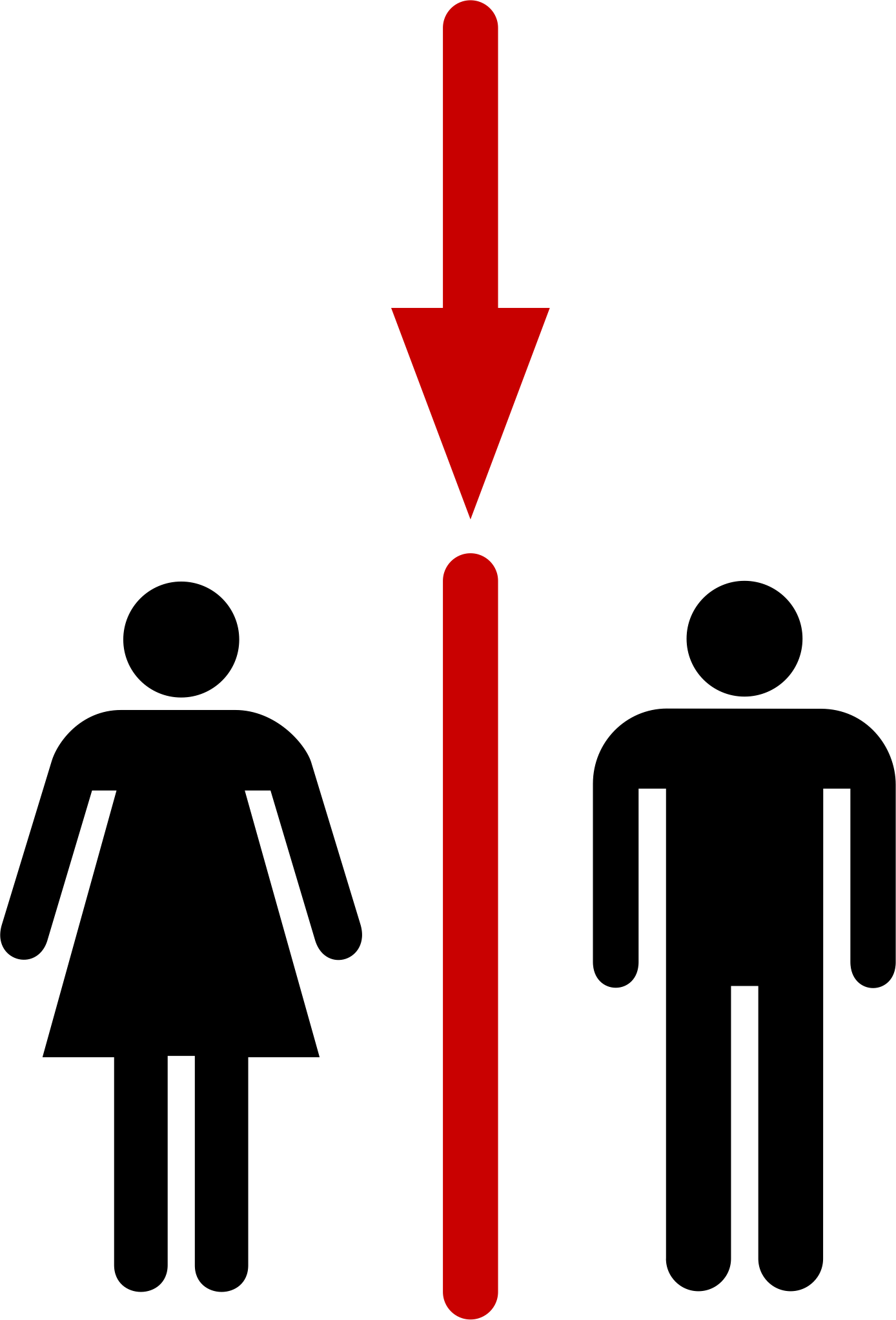
One of our main research themes in recent years is categorisation. What do categorisations create, and what characterises the categorisations that do not lead to inequality and stigma? In this pictogram I single out the separation into “woman” (Kvinna) and “man” (Man) on toilet doors.
The slide does not argue against gendered signs. It asks what the signs do: sorting bodies into types, naming the types, and assigning each type a route. Once that is visible for kvinna and man, the same reading becomes available for the wheelchair sign, and for “persons with disabilities” in policy text.
Download
References
- Ericsson, S., Wojahn, D., Sandström, I., & Hedvall, P.-O. (2020). Language that Supports Sustainable Development: How to Write about People in Universal Design Policy. Sustainability, 12(22), 9561. https://doi.org/10/ghrshm
- Ericsson, S., & Hedvall, P.-O. (2024). Situation, Non-categorisation, and Variation — Conveying Nonclusion Through Text and Image. In Difference: Sketching, Visualising and Challenging Universal Design in Sweden (Vol. 19, pp. 31–50). Design for All Institute of India.
- Hedvall, P.-O., & Ericsson, S. (2024). From Inclusive to Nonclusive Design: A Shift in Categorisation. In Difference: Sketching, Visualising and Challenging Universal Design in Sweden (Vol. 19, pp. 10–30). Design for All Institute of India.
License: Open Educational Resource
Everything I have created here is shared under the Creative Commons Attribution 4.0 International license (CC BY 4.0).
You may:
- Share: copy and redistribute the material in any medium or format.
- Adapt: remix, transform, and build upon the material.
Under the following condition:
Attribution: give appropriate credit and indicate if changes were made. A simple "Per-Olof Hedvall, peohedvall.com" is enough.
This applies only to content I have created. Any third-party content, such as quoted images, may be under a different license and is marked accordingly.