Collingridge's dilemma
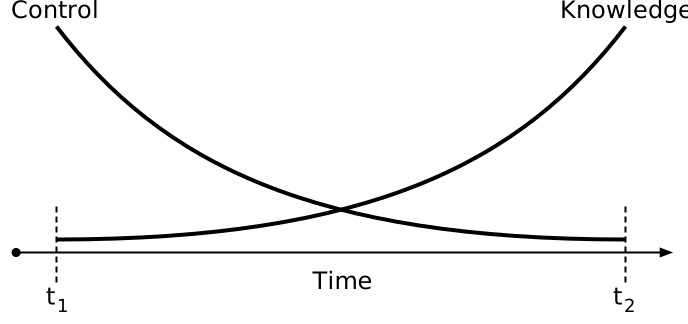
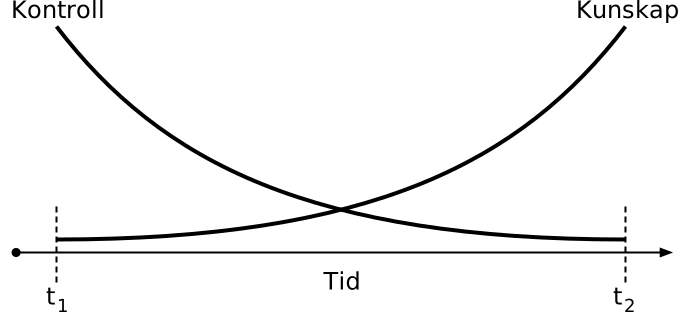
Knowledge and control move in opposite directions over the life of a design.

What it is
I sometimes bring in Collingridge’s dilemma. David Collingridge wrote: “When change is easy, the need for it cannot be foreseen. When the need for change is apparent, change has become expensive, difficult, and time-consuming.”
For anyone working with access and use, like me, the parallel is easy to recognise. Accessibility, usability and Universal Design need to be part of the design process from the very start, when the least is known about the end result and the potential for access and use is at its highest. The two curves cross. Control over the decisions is highest when knowledge of their effects is lowest.
Download

References
- Collingridge, D. (1980). The social control of technology. Frances Pinter; St. Martin's Press.
- Genus, A., & Stirling, A. (2018). Collingridge and the dilemma of control: Towards responsible and accountable innovation. Research Policy, 47(1), 61–69. https://doi.org/10.1016/j.respol.2017.09.012
- Hedvall, P.-O., Ståhl, A., & Iwarsson, S. (2022). Tillgänglighet, användbarhet och universell utformning. In V. Denvall & S. Iwarsson (Eds.), Participation (pp. 151–181).
License: Open Educational Resource
Everything I have created here is shared under the Creative Commons Attribution 4.0 International license (CC BY 4.0).
You may:
- Share: copy and redistribute the material in any medium or format.
- Adapt: remix, transform, and build upon the material.
Under the following condition:
Attribution: give appropriate credit and indicate if changes were made. A simple "Per-Olof Hedvall, peohedvall.com" is enough.
This applies only to content I have created. Any third-party content, such as quoted images, may be under a different license and is marked accordingly.