The Bell Curve
Have we built our society on too narrow a base? The figure I reach for most.

What it is
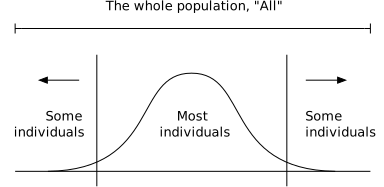
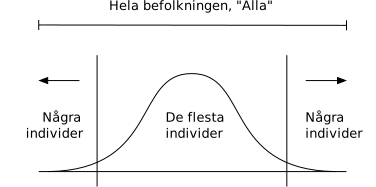
This is the illustration I reach for most. It is a bell curve over the population. Most people are in the centre, while some are out on the edges, excluded or marginalised. This way of thinking is the foundation for how accessibility is conceptualised in standards and guidelines.
I use it to make a point that runs against that picture. The centre is not where we learn the most about the flexibility human diversity needs. It is at the outer edges, among the people called “extreme users”, “edge cases” or “fringe cases”, that we find those who can tell us most about what they struggle with and what supports them. That is also where the current non-users are. As Dan Formosa puts it in the documentary Objectified: “If we understand what the extremes are, the middle will take care of itself.”
Download

References
- Hedvall, P.-O., Ståhl, A., & Iwarsson, S. (2025). Accessibility, usability and universal design – still confusing? Harmonisation of key concepts describing person-environment interaction to create conditions for participation. Disability and Rehabilitation, 1–10. https://doi.org/10.1080/09638288.2025.2491831
- Hedvall, P.-O., Price, M., Keller, J., & Ericsson, S. (2022). Towards 3rd Generation Universal Design: Exploring Nonclusive Design. UD2022, Italy.
- Documentary: Objectified (dir. Gary Hustwit, 2009). Freely viewable at documentaryheaven.com/objectified.
License: Open Educational Resource
Everything I have created here is shared under the Creative Commons Attribution 4.0 International license (CC BY 4.0).
You may:
- Share: copy and redistribute the material in any medium or format.
- Adapt: remix, transform, and build upon the material.
Under the following condition:
Attribution: give appropriate credit and indicate if changes were made. A simple "Per-Olof Hedvall, peohedvall.com" is enough.
This applies only to content I have created. Any third-party content, such as quoted images, may be under a different license and is marked accordingly.